استفاده از دیش ماهواره ای برای ساخت آنتن وایرلس 802.11b پرقدرت
Construction of the Biquad
I used Printed Circuit board scraps for the 110 x 110 mm reflector, but it will be just as effective if made out of sheet brass or copper. Aluminum can be used if soldering of the rigid coax is not required at the feed point.
The reflector's 'lips' are 30 mm high, and serve to reduce coupling into the mounting bar. Note that they are only required along the main edge axis of the reflector. The lips cut down radiation from the rear lobes of the biquad by about 6 dB
The best SWR is obtained when the biquad loop is about 15mm above the ground plane, and the SWR may be adjusted by varying this distance.
If you are making a stand-alone antenna, rather than a feed, you will get better gain from a reflector 123 x 123 mm
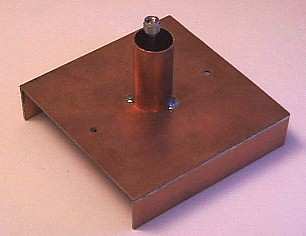
A piece of 3/4 inch copper piping makes a tight fit with the mount supplied on the Primestar dish
The rigid 0.141 diameter coax is soldered to the groundplane to provide physical support for the structure. If the biquad element is constructed carefully there will be no component of radiation along the axis of the coax, no current is induced into the coax outer conductor, and a balun is not needed.
An SMA connector can be seen on the end of the rigid coax used to support the biquad element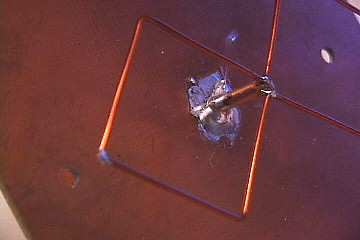
To make the element take a piece of 1.2mm bare or enamelled copper wire exactly 244 mm long. Bend it in half, and then make the bends at the halfway point on each leg (where the solder joints will be). Then bend the 4 remaining right angles so that the element sides are rectangular, and there is about a 1.5mm gap for soldering to the feed. The widths of the two quad elements will be approximately 30.5mm, from wire center to wire center.
You may use standard coax cable to connect at this point, if you do not have rigid cable available, but you will have to figure out how to support the loop physically.
The best SWR is obtained when the loop is about 15 mm above the ground plane and when the reflector is mounted about 10mm in front of the Primestar's feed bracket
That's all there is to it, folks -- you now have a dish with 27-31 dBi of gain and negligable sidelobe radiation (<40dB). The beamwidth is about 4 degrees. 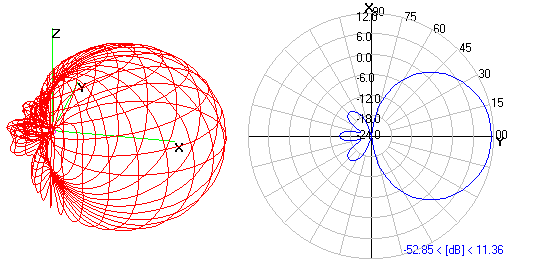
 ***شرکت شایان توسعه البرز***